Wednesday, February 19, 2014

For Parents, On Financial Aid

After being accepted by a college or university, the next big hurdle is financial aid.  The Financial Aid process can feel like a maze of details and forms - merit scholarships, need-based scholarships, FAFSA, additional applications, tax information, grants, loans, and on and on.  So how to maneuver through this mess?  Every year, Amber Thompson our registrar, hosts a financial aid meeting with Senior and Junior parents.  This meeting is led by an admissions counselor from a local college and has proved very helpful in years past.  One of the major topics covered at this meeting is the FAFSA (Free Application for Federal Student Aid).  The federal government and many colleges use the FAFSA as a measurement to determine the amount of financial aid your family would need in order to send a student to college.  Below I have included an article from College Make Simple, a website with tips and tricks for the college application process.  This particular tip is about the importance of filling out the FAFSA even if you think it won't make a difference in your financial aid package.
_________________________________________________________________________________

Dear College Made Simple reader,
Every year, a number of families make a huge mistake.
They don’t fill out and submit their FAFSA.
Some are guilty of simple mistakes – waiting too long to submit their application, not correcting errors in an application – but the majority who make this mistake do it on purpose.
They figure they’re not eligible for financial aid, due to income or savings they think is too high. Why bother doing the application, when there’s no money that will come your way?
If you choose not to fill out a FAFSA – no matter what your situation – you could be shooting yourself in the foot. In today’s College Made Simple report, we explain why…
- Scott
Financial Aid Eligibility: Why It’s Always a Good Idea To Submit the FAFSA
Most people who don’t fill out the FAFSA think they won’t be able to get the money. They could be wrong.
Situations change. Jobs are sometimes lost, health issues sometimes arise that prevent work (or drain savings). A new baby might come into the picture – or, unfortunately, a bread winner might pass.
The future can’t be known – but one thing you can know, if you don’t file a FAFSA, you can’t adapt to changing circumstances. Even if you won’t be eligible for aid today – you might be tomorrow.
Further, many merit scholarships require a FAFSA. So even if you don’t qualify from need, you might qualify thanks to achievement.
Of course, if you don’t fill out a FAFSA, you’ll never find out.
Finally, any student loans you might take out require a FAFSA as well. Even if you’re perfectly capable of affording school – sometimes it makes sense to take out a loan anyway.
In some cases it’s to avoid running down retirement savings – or, perhaps, to give a student a fine lesson in financial life as well, even if just with a token loan.
In short, there are a few good reasons to fill out a FAFSA that have nothing to do with need. And, as a type of insurance, everyone should fill out a FAFSA, just in case a family’s financial fortune takes a sudden turn south.
To your college funding & admissions success,
Scott Weingold
Co-Founder, College Planning Network LLC
Publisher, CollegeMadeSimple.com – The free educational resource of College Planning Network

Monday, February 3, 2014

Congratulations!

Congratulations to our seniors on their college acceptances!

Savannah West - Wofford College and Presbyterian College
Samuel Glenn - Furman University and Wofford College
Nicholas Miron - Clemson University
Emma Knight - Presbyterian College, Appalachian State University, and James Madison University

Monday, January 27, 2014

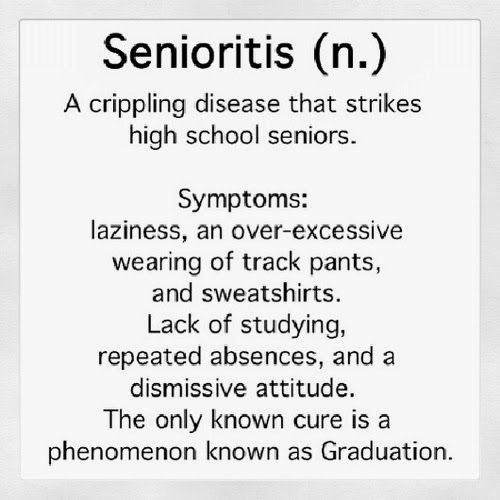
Got Senioritis?

Has spring semester just begun and you already don't have any motivation to do your school work?  Do you just want to sit around in sweatpants and watch TV or hang out with friends?  You might have a common problem among high school seniors called senioritis.  While this is a normal sentiment among high school seniors, be careful you don't get drawn too far down that path.  Just because you have already been accepted into college doesn't mean that your dream school cannot withdraw their acceptance if they are not impressed with your final grades.
So how can you overcome senioritis?  Lots of tips exist out there on the internet, ranging from having a "just do it" mentality to scare tactics about losing college acceptances or scholarships.  But here are some helpful and practical tips from the CollegeBoard:


  • Maintain a challenging course load. Urge them to take the most rigorous courses available, including AP courses (for which they can earn credit at many colleges).
  • Enjoy their senior experience — responsibly. Encourage them to celebrate the last year of school. They may enjoy cheering at football games, going to the prom, attending graduation festivities, and participating in clubs, sports and volunteer work.
  • Commit to an internship or career-focused job. This can help them make informed decisions about their education and career goals. Or they can try out college early by taking a class at a local college in a subject that interests them or in which they excel.
  • Keep a calendar of their activities and deadlines. This includes tests, college applications, senior-year events and extracurriculars. Caution them not to overextend themselves.
  • Avoid obsessing over the admission process. If they do, everything else, including grades, suffers. It's all about balance and making the right choices.
Hang in there, seniors, graduation will be here before you know it!

Thursday, January 23, 2014

Congrats!

Congratulations to all our Seniors as they continue to hear back from colleges!  Here is the most recent list of acceptances:

Chris Verdin - Mercer College
Seth Garrison - Clemson University and University of South Carolina
Samuel Glenn - University of South Carolina Honors College
Phillip Carter - Lander University
Elizabeth Ellis - University of Virginia
Jesse Turner - Erskine College


Friday, December 13, 2013

Friday, December 6, 2013

Congratulations!

Congratulations to Jon Jones on his acceptance to Spartanburg Methodist College!

Tuesday, December 3, 2013

Experience vs. Performance

Two weeks ago, SFCS sent High School and Middle School delegations to the 2013 Youth In Government (YIG) Conference in Columbia, SC.  Youth in Government is a YMCA-sponsored event that brings together middle and high school students from all over the United States in a three-day conference where students gain a glimpse into the inner workings of the state government process. During the conference, students propose, write, and defend bills, run for offices for the next year, and meet state legislators. 

This year was especially great for the SFCS delegation – seven SFCS bills were signed into YIG law; four middle school students and one high school student were named Outstanding Statesmen; two SFCS bills earned the Outstanding Bill Award; and both delegations were named Premier Delegations.   (For more details and pictures, visit http://shannonforest.com/headlines.html.)

So what could possibly make this experience just as important as the SAT – a nationally recognized method of evaluating college applicants?   

The SAT by nature is designed to provide a generalized snapshot of an individual.  It is one-dimensional and says very little about the person, in that it cannot distinguish between two students who have the same scores.  Without any other information, a college admissions representative could view both students as essentially equal. 

Youth In Government, in contrast, allows our students to show what they are able to accomplish in the real world.  YIG participants participate in a student-run government system that not only gives them a glimpse into the “grown-up world” of politics, but requires them to think critically, communicate clearly and rationally, and to take responsibility for their decisions and actions.  It is incredible what these young adults are able to accomplish through their own initiative when given the opportunity. 

Don’t mistake me, I am not saying that your 11th grader shouldn’t take the SAT just because it is limited in its ability to truly distinguish between students.  However, I am suggesting the personal and educational value of experiences such as Youth In Government should not be ignored.  Shannon Forest Christian School has created several opportunities for students to gain experience with the real world which we encapsulate under the heading Shannon Experience.  These include the EXPLORE program for 10th graders through which they investigate potential careers and participate in an internship program with businesses around Greenville; the PURSUE program during which 11th graders visit college campuses, talk about potential majors, and discuss their goals and dreams for college; IMPACT and CONNECT which bring our Lower and Upper School students together through community service projects. 

Here at SFCS we want to provide your child with a well-rounded education – one in which they are well-versed in the fundamentals of math, history, English, and science, but also one that has allowed them to become confident, thoughtful, creative, empathetic individuals who can truly impact their communities for Christ.